Chen Feier on distraction, decision-making and learning to do research
Chen Feier arrived with an interest in psychology and a question about what lies behind behaviour. Eight days at the Brain and Cognitive Science Research Summer School gave her a first taste of designing a study of her own.
Why brain science?
I was already interested in psychology. When I first came across psychology and expressive arts activities, I paid most attention to the behaviour I could see in people and animals. After a while, I kept asking what was happening in the brain to make that behaviour possible. That was what brought me to the programme.
I felt nervous as well as excited. I knew the academic work would be more demanding than some of the programmes I had tried before. At the same time, I wanted to learn something new and meet the tutors and the other students.
Finding a question of my own
The original plan was for five of us to work on a research design together. By the second day, with the tutors’ help, each of us had an idea we wanted to follow. We ended up developing our own designs. That change gave me a real sense of having to think independently.
Once I started, I began doubting the point of my project. What would it actually tell us? The tutors worked with us individually. They helped me break a large question into smaller parts and gave me a clear way of thinking through what I needed to do next.
My topic was how outside interference might affect judgements in perceptual decision-making. The night before my presentation, I was still looking for papers that connected interference with confidence in a decision. I could not find what I wanted on CNKI, the Chinese academic database, and I worried that my presentation had a gap.
Talking with a teaching assistant helped me look at the problem differently. Instead of only worrying that I could not find an existing answer, I could think about what I wanted to investigate and why. It helped me regain a sense of purpose.
Arguing about a possible future
In one activity, we imagined it was 2035 and held a courtroom debate about whether brain–computer interfaces should be allowed in China’s university entrance examination. Taking different roles meant thinking through the benefits and the difficulties of using a new technology. A research question suddenly felt much more immediate.
We also visited a site where we could see brain science equipment being used. Watching a fellow student try an EEG recording, and seeing the signal change on screen, made the subject feel much closer than it had in a textbook.
“Now, when I notice something in everyday life, my first thought is often: could I turn that into an experiment?”
Chen Feier
Making room for other kinds of thought
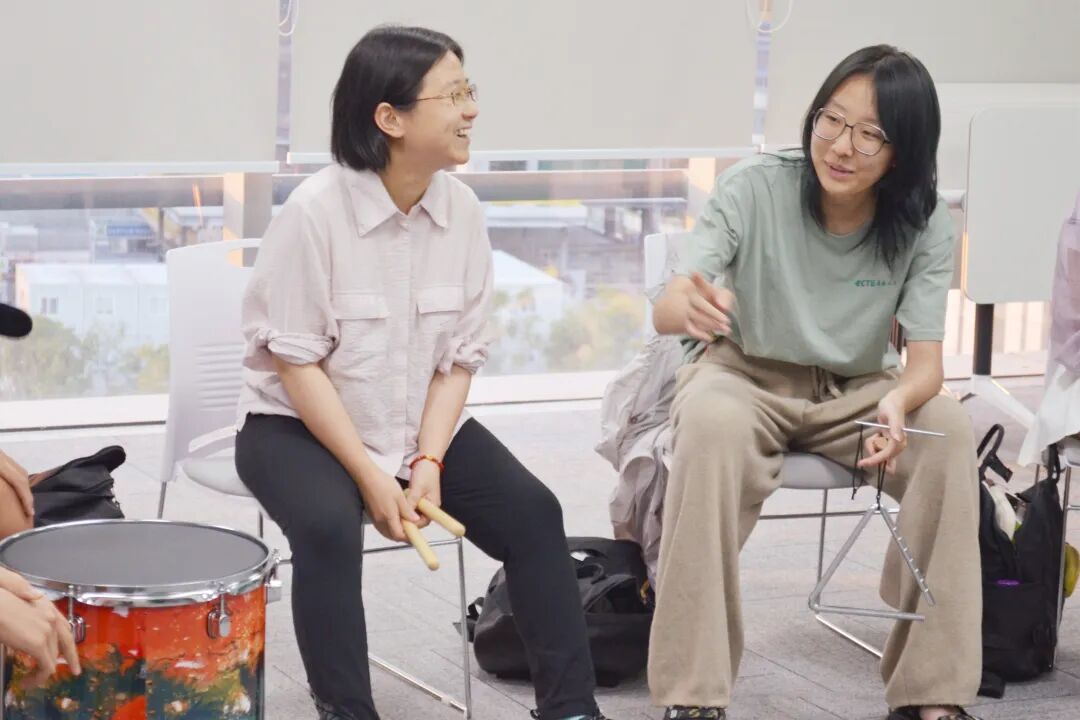
The research work was only part of the week. In an activity led by Gao Qi, we invented words for experiences we found difficult to describe. I made one about writing things down when there is no one to talk to, and another about the way friends come and go at different stages of life.
A group drama activity also stayed with me. We chose fixed movements for anger, sadness and happiness, then put them together to form a large “emotion machine”. It was a way of noticing other people’s feelings through movement rather than speech.
What has stayed with me
I have started carrying some of the research thinking into ordinary life. On a journey, I noticed that listening to music seemed to make me feel less travel sick. I wondered whether that observation could become an experimental question. When I have to design something, I now think about asking people what they need before deciding on a solution.
Before the summer school, I pictured myself going into counselling. I still find that work interesting, but I can now imagine doing research as well. I would like to keep exploring both.
For someone who already enjoys psychology and wants to look beyond the areas they know, I think this programme is worth considering. I found the atmosphere open and accepting, even when the work was challenging.